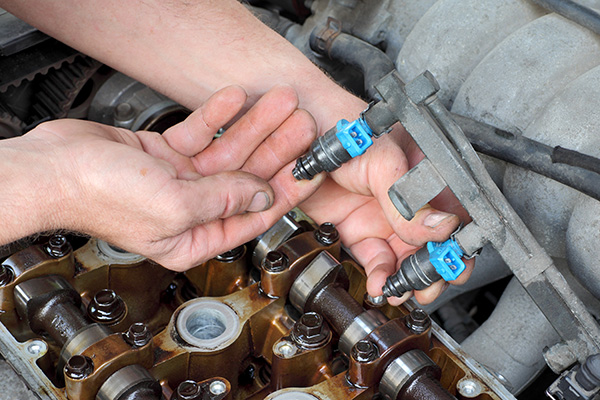
Fuel injectors have a simple job on paper. They deliver the right amount of fuel into the engine at the right time. In practice, they have to do that thousands of times while dealing with heat, fuel deposits, pressure changes, and very small internal passages.
When an injector starts getting dirty or partially clogged, the engine usually does not stop running altogether. Instead, it starts showing smaller drivability problems such as rough idle, hesitation, weak acceleration, or inconsistent fuel economy. Those symptoms overlap with several other engine problems, so we look at the full picture before blaming the injectors.
Rough Idle Can Point Toward Uneven Fuel Delivery
A dirty injector can change the amount or spray pattern of fuel entering one cylinder. If that cylinder is getting less fuel than the others, the engine may shake or feel uneven while idling.
At our shop, we look at misfire counts and fuel trim data while the engine is running. If one cylinder repeatedly contributes less than the others, the injector becomes one part of the diagnosis. Spark plugs, ignition coils, vacuum leaks, and compression problems can create similar symptoms, so a rough idle alone does not prove the injector is clogged.
Hesitation Under Acceleration Is Another Useful Clue
Fuel demand increases quickly when you press the accelerator. A restricted injector that seems acceptable at idle can struggle to deliver enough fuel once the engine is under load.
You might feel a flat spot, stumble, or short hesitation when pulling away from a stop or merging into traffic. In more noticeable cases, the engine can feel like it is briefly running out of power before catching up. We pay attention to when the hesitation happens because a fuel delivery problem under load can point us in a different direction than an idle-only issue.
A Clogged Injector Can Cause Misfire Codes
The engine computer monitors crankshaft speed closely enough to detect when a cylinder isn't contributing normally. If an injector is restricted enough, that cylinder can begin misfiring and eventually trigger the check engine light.
A stored cylinder-specific misfire code tells us where to start, but it does not identify the failed part by itself. We still have to determine whether the cause is fuel, spark, compression, or air. Depending on the engine, we may compare injector operation, swap components for testing, or perform additional fuel system checks before recommending parts.
Fuel Economy Can Get Worse for More Than One Reason
Dirty injectors can hurt fuel economy because the engine no longer gets a clean, consistent fuel spray. Combustion becomes less efficient, and the computer may begin adjusting fuel delivery to compensate for what its sensors are seeing.
The opposite problem can happen too. An injector that leaks rather than clogs can deliver too much fuel, creating a rich mixture, fuel smell, rough running, or hard starting after the vehicle sits. That is why we do not use poor mileage alone as proof that injector cleaning is needed.
Watch for Several Symptoms Showing Up Together
One symptom can have many possible causes. When several fuel-related symptoms show up at the same time, the injector system deserves a closer inspection.
Common signs include:
- Rough or uneven idle
- Hesitation during acceleration
- Cylinder misfire codes
- Loss of power under load
- Hard starting
- Poor fuel economy
- Fuel smell from the exhaust
- One spark plug that looks different from the others
The pattern matters more than any single item. A car with a rough idle and a clean bill of health on the ignition side tells us something different from one with worn spark plugs and no evidence of fuel delivery issues.
Injector Cleaning Does Not Fix Every Fuel Problem
Fuel injector cleaning can help when deposits are restricting an otherwise healthy injector, but it is not a cure for a failed electrical coil, internal mechanical damage, or a leaking injector.
We first determine what type of problem we are dealing with. If deposits restrict flow, cleaning may restore a better spray pattern. If the injector does not respond electrically or leaks when it should be closed, replacement is usually the more appropriate repair.
Fuel Quality and Driving Habits Affect Deposit Buildup
Modern fuel systems are designed to stay clean for a long time, but driving conditions still play a role. Frequent short trips, extended idling, long periods of storage, and certain operating conditions can contribute to deposit buildup.
Regular maintenance helps us catch drivability changes before they become severe. We also look at the fuel system as a whole because low fuel pressure, a weak pump, contaminated fuel, or a faulty pressure regulator can create symptoms that look almost identical to clogged injectors.
Testing Is Better Than Replacing Injectors Based on Symptoms
Fuel injectors can be expensive, especially on direct-injection engines, so replacing them without proper testing is not a good first move. We prefer to confirm the fault with scan data and mechanical checks before recommending a repair.
Depending on the vehicle, that can include fuel pressure testing, injector balance testing, electrical testing, misfire analysis, or checking how individual cylinders respond. An inspection that separates an injector problem from an ignition or compression issue saves time and prevents unnecessary parts replacement.
Get Fuel Injector Service In Atlanta, GA, With Atlanta Car Care
If your engine has developed a rough idle, hesitation, repeated misfires, or a noticeable loss of power, Atlanta Car Care in Atlanta, GA, can inspect the fuel and ignition systems to determine whether dirty or clogged injectors are involved.
Schedule a fuel system inspection before an intermittent drivability problem becomes harder to ignore.