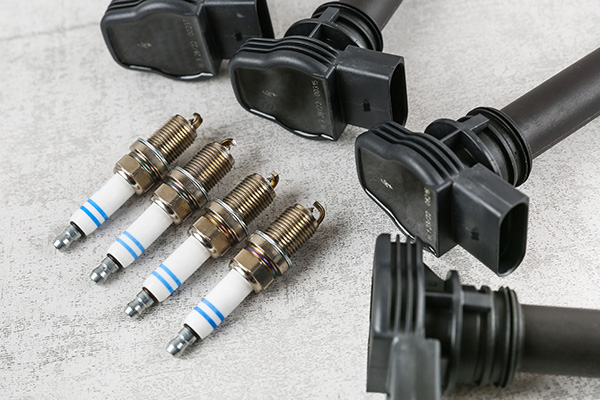
This question usually comes up right after someone gets hit with a quote or right after a misfire. Spark plugs are normal maintenance, but ignition coils feel more like a repair, so it’s natural to wonder if you should just do everything at once and be done with it.
Sometimes that’s the smartest move. Other times, it’s unnecessary money up front. The right answer depends on mileage, symptoms, and how the car has been maintained.
What Each Part Does And Why They Get Blamed Together
Spark plugs ignite the air and fuel in each cylinder. Ignition coils provide the high voltage that makes that spark happen. On most modern engines, each cylinder has its own coil, sitting right above the plug. Because they work as a pair, one weak component can make the other work harder.
Worn plugs can increase the gap and make it harder to fire the spark. That extra demand can stress coils over time. A weak coil can cause incomplete combustion, leaving deposits on the plug and making it look worse than it really is. That’s why people often talk about plugs and coils together, even though they don’t always need to be replaced as a set.
When Replacing Both Together Makes Sense
If your plugs are due and the coils are the same age with high mileage, replacing both can be a cost-smart decision. You avoid paying labor twice, and you reduce the chance of a second repair soon after. This is especially true on engines where access is time-consuming, or where coil failure is common as mileage builds.
It also makes sense if you’ve already had multiple coil failures over time. If you’ve replaced one coil this year and another last year, the remaining older coils may not be far behind. At that point, it becomes less about if they’ll fail and more about when.
When It’s Better To Replace Only The Plugs
If the car has no misfire symptoms and you’re doing routine maintenance, plugs alone are often fine. Many coils last a long time when plugs are replaced on schedule. If the coils are newer or the vehicle has a history of coil replacements, there’s usually no reason to toss good coils just because the plugs are being serviced.
Plugs are also a good first step when the engine has mild hesitation or a rough idle and the plugs are overdue. In a lot of cases, fresh plugs restore smoothness, and you never need to touch the coils.
Signs Coils Are Getting Weak
Coil problems often show up as intermittent misfires. You might feel a stumble under acceleration, a shake at idle that comes and goes, or a problem that gets worse once the engine is hot. Some drivers notice the issue more in humid weather. Others notice it only when they’re merging or climbing a hill.
If the same cylinder keeps showing misfire activity, and plug condition looks normal, the coil for that cylinder becomes a stronger suspect. Another clue is if the engine runs rough and then suddenly smooths out, because coils can fail in a way that’s inconsistent at first.
Owner Mistakes That Lead To Repeat Misfires
One common mistake is replacing a coil but leaving worn plugs in place. That new coil may run fine, but it’s still trying to fire across an oversized plug gap, which shortens its life. Another mistake is using the wrong plugs or an incorrect gap. Some engines are picky, and a plug that’s close but not correct can create misfires that feel like a bad coil.
We also see people replace coils one at a time without considering age and mileage. Sometimes that’s fine, but sometimes it turns into a cycle where a new coil goes in every few months. If the rest are old and brittle, it’s worth thinking about a broader plan.
A Cost-Smart Decision Guide For Plugs And Coils
If your car is due for plugs and you’re not having misfires, plugs only is usually the reasonable move. If you’re due for plugs and you’ve had coil failures recently, replacing both may save you repeat visits. If the engine is actively misfiring, the best move is to confirm whether it’s a plug or coil issue, or something else.
Another factor is how long you plan to keep the vehicle. If you’re keeping it for years and you want reliability, doing coils with plugs can be worth it on some platforms. If you’re planning to sell soon, you may prefer a targeted repair with solid testing behind it.
After-The-Fix Habits That Help Ignition Parts Last
Ignition parts last longer when the engine runs clean. Fix oil leaks that drip into plug wells. Address valve cover issues that let oil pool around coils. Keep up with basic maintenance like air filters, because a consistently running engine puts less stress on ignition components.
If you ever notice a misfire that comes and goes, don’t ignore it for months. That’s usually the early stage. Catching it early can prevent catalytic converter damage and can keep the repair focused on the ignition system instead of turning into a bigger conversation.
Get Spark Plug Service in Atlanta, GA with Atlanta Car Care
If you’re due for spark plugs, dealing with a misfire, or trying to decide whether coils should be replaced at the same time, we can help you make the right call. We’ll check plug condition, verify coil performance when needed, and recommend a plan that fits your vehicle and your goals.
Get spark plug service in Atlanta, GA with Atlanta Car Care, and we’ll help you keep your engine running smooth and dependable.